
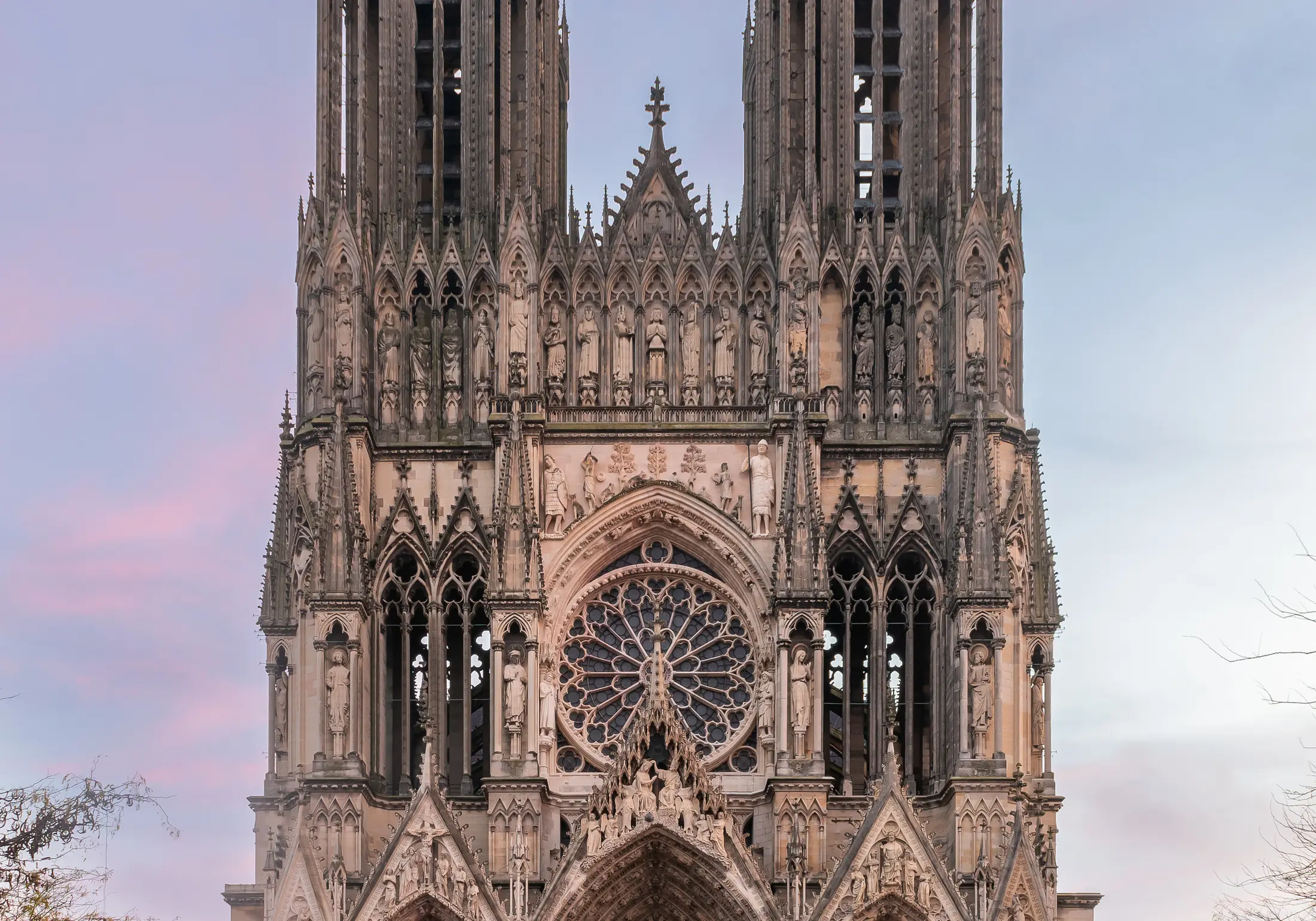
The cathedral and September 1914
Reims stood on or near the front line for four years from September 1914. German shells struck Notre-Dame on 18 September; on 19 September, fire spread through scaffolding and straw inside the building. The cathedral’s stone figures, roof and interior became symbols of the destruction of the city. The two dates describe successive parts of the same catastrophe, instead of two interchangeable dates for the fire.
Around 300 further shells struck the cathedral during the war, while about 85 per cent of Reims’s buildings were destroyed. These figures are reported by Smithsonian Magazine in its account of the debate over reconstruction. The city’s survival underground and the rebuilding above ground are therefore connected stories: the cathedral is one highly visible part of a much wider urban disaster.
The Smiling Angel on the west façade lost its head during the destruction. The monument’s own history records the damage on 19 September 1914 and the later restoration of the sculpture. Look at the north portal of the west front for the figure today. Its present appearance belongs to a repaired building; the site does not survive untouched from the war.
Rebuilding the cathedral
Henri Deneux directed the post-war reconstruction, assisted by major Rockefeller donations. The Centre des monuments nationaux describes donations beginning in 1924 and an innovative roof structure using reinforced-cement elements. French state funding supplied the greater part of the works, so the restoration should not be reduced to a single donor’s gift.
The cathedral reopened on 10 July 1938, a date reported in Smithsonian’s reconstruction history. That reopening came almost twenty years after the armistice. For a visitor, the long timetable explains why a photograph of the repaired façade and a photograph of the ruined roof can belong to very different phases of the city’s recovery.
Notre-Dame, the former Abbey of Saint-Remi and the Palais du Tau form the separate Reims World Heritage inscription of 1991. The Champagne Hillsides, Houses and Cellars inscription dates from 2015 and includes the Saint-Nicaise cellar landscape. The UNESCO guide explains those two designations; the wartime journey crosses places associated with both.
Civilian life in the crayères
The former chalk quarries and Champagne cellars provided shelter for families during the bombardment. Bottle racks helped divide spaces and canvas supplied privacy. Some cellars became hospitals; the spaces now occupied by Taittinger also held a school. The cellars were working production and storage places before they acquired these emergency civilian uses.
The school was named for General Augustin Dubail. Taittinger’s historical account, drawing on the work of historian Jérôme Buttet, records about 250 people living together in one cellar. Children were allowed up only as far as the ground floor for fresh air, and births took place underground. These are details of civilian occupation instead of an invented reconstruction of a particular family’s experience.
Champagne-making continued during the conflict. Today’s guided route passes through production heritage that also preserves wartime memory, including marks left by people using the underground spaces. A contemporary tasting ticket is a visit to a working house’s historic site; the relevant family-history or cellar format determines how much of that story is included in the tour.
The house tour with a confirmed wartime connection
Taittinger is the confirmed house stop for this theme. Its current visitor information describes the Saint-Nicaise site’s Gallo-Roman, medieval and First World War history; Instant Famille is the named family format with a children’s art activity. The October 2026 booking information gives 70 minutes, an adult ticket of €40 (about £34) and a child ticket of €25 (about £21), with the format aimed particularly at ages six to twelve.
The visitor entrance is 9 place Saint-Nicaise, Reims. The cellar route lies about 18 metres below the surface and includes numerous stairs; the house’s visitor FAQ gives approximately 12°C underground. Bring a layer and ask about the actual route if stairs or low-light spaces affect your visit. These conditions belong to the cellar appointment, not to an exterior walk around the cathedral.
The standard Instant Rosé option also lasts 70 minutes and starts at €40 (about £34) per adult (checked October 2026), with Brut Réserve and Prestige Rosé. Select the history-focused family option when that is the purpose of your visit. Other Reims houses have historic cellars, but no additional producer is presented here as offering a guaranteed First World War tour without a matching programme description.
Fort de la Pompelle
The Musée du fort de la Pompelle is on the RD 944, route de Châlons-en-Champagne, at Reims–Puisieulx. Its collections cover the defence of Reims and soldiers’ lives, with French uniforms, personal equipment, trench objects and the Friese collection of Imperial German military headgear. The fort adds the military defensive landscape to a weekend otherwise focused on civilian shelter and the damaged city.
Current opening is 10:00–18:00, closed Mondays and on 1 January, 1 May, 1 November and 25 December. The museum also announces an exceptional closure on Tuesday 27 October 2026. These arrangements were checked in October 2026; the general weekly timetable does not override that named closure.
The standard adult admission is €5.50 (about £5) (checked October 2026), with tickets bought at reception. The municipal museum information distinguishes reduced categories and free admission, including under-18s and specified disability-and-companion arrangements. The first Sunday of the month is free, and 11 November has a fort-specific free-entry provision. Use the operator’s current visitor information for any exhibition supplement.
The fort is outside the central cathedral-and-cellar walk. Arrange the outward and return transport to the RD 944 address separately from a Saint-Nicaise tour. For a booked taxi or driver, give the museum’s full name and reception address; the Musée de la Reddition is another museum in another part of Reims, and its similar military theme does not make the two entrances interchangeable.
A weekend sequence based in Reims
On the first day, begin at Notre-Dame and the Smiling Angel on the west front, then continue to a reserved Taittinger visit at Saint-Nicaise. The guide’s mapped cathedral-to-Taittinger route is approximately 1.6 km and 22 minutes on foot, excluding stops. Place the paid appointment before fixing lunch, because the selected tour language and departure time determine the available break.
Brasserie du Boulingrin at 31 rue de Mars is a named lunch option with a €27 (about £23) formula, checked October 2026; its advertised order-taking week is Monday–Saturday. Café du Palais at 14 place Myron Herrick is another city-centre address near the cathedral. The Reims food guide gives the restaurant details instead of treating a meal as included in the cellar booking.
Use the second day for Fort de la Pompelle and, if the timetable permits, the surrender museum as a later historical coda. Monday closes the fort and Tuesday closes the surrender museum, so the two attractions have different weekly constraints. A Sunday can include the fort’s normal opening, while a weekend spanning 1 November needs the national-holiday closure considered as well.
The Second World War coda: the surrender museum
The Musée de la Reddition du 7 mai 1945 is at 12 rue Franklin Roosevelt. Its War Room preserves the location where the German surrender was signed at 02:41 on 7 May 1945. This is a Second World War event, separated by more than a generation from the First World War shelter story at Saint-Nicaise.
The museum reopened on 7 May 2026 after a redevelopment, with a new chronological presentation around the preserved map room. Current visitor hours are 10:00–18:00 except Tuesdays, with closures on 1 January, 1 May, 1 November and 25 December. Its location on the station side of the centre makes it a different practical outing from the road journey to the fort.
The municipal tariff lists €5.50 (about £5) for a standard adult museum visit (checked October 2026). Read the dated museum programme for supplements and free-entry conditions, and use the Reims sights guide for the other city museums. A free cathedral visit, a house ticket and a museum admission remain three separate parts of the weekend.
Read the surviving places together
The cathedral façade, the underground shelter spaces and the fort tell different parts of the same conflict. Give each one its own context: destruction and reconstruction in the centre, civilian survival at Saint-Nicaise, and military defence beyond the city. A weekend does not need a continuous sequence of paid visits to make those connections. Leave time to read the interpretation and compare the dates before moving on.
Questions and answers
Which Champagne house has a confirmed wartime-school connection?
Taittinger’s present Saint-Nicaise cellars housed the Augustin Dubail school during the First World War; the house’s history and family-visit information describe this connection.
Is the surrender museum about the First World War?
No. It preserves the room where the German surrender was signed on 7 May 1945 during the Second World War.
Can I visit Fort de la Pompelle on Monday?
The current normal timetable closes it on Mondays, with additional annual and exceptional closure dates.
Plan your trip to Reims
Get there
Book a tour
Select the departure point and date on the booking page. Check the meeting point, language and inclusions before paying.
Compare toursWe may earn a commission if you book through these links, at no extra cost to you.