

History
Joseph Krug founded his Reims house in 1843. Five years later, in 1848, he set down its principles in a dark-cherry notebook. Individual vineyard wines and a collection of reserves provided the basis for recreating a champagne each year. Olivier Krug represents the sixth generation of that family history.
The Grande Cuvée edition system continues the blending approach. The 173ème Édition, built around the 2017 harvest, contains 150 wines from thirteen different years, extending back to 2001. It belongs to the multi-year Grande Cuvée sequence, while Krug Vintage carries an individual harvest year.
Rémi and Henri Krug developed Clos du Mesnil from the 1979 harvest and presented the first wine in 1986. The vineyard comprises 1.84ha of Chardonnay in Le Mesnil-sur-Oger, below the village church. Its enclosing walls date from 1698, considerably earlier than the champagne house.
Clos d’Ambonnay followed a separate search for Pinot Noir. Rémi and Henri discovered the 0.68ha plot in 1991 and bought it in 1994. Walls have enclosed it since 1766. The first wine used the 1995 harvest and was unveiled twelve years later, in 2007.
The idea for Krug Rosé dates to 1976. Its first release followed seven years later, adding a rosé to a range already centred on Grande Cuvée and vintage wines. Later numbered editions record their own blends: Rosé 29ème Édition brings together twenty-nine wines from five years.
Krug introduced the six-digit Krug iD on back labels in 2011. Edition numbers became part of the front labels for Grande Cuvée and Rosé in 2016. These two changes made the composition and creation of individual releases easier to trace through the house’s online records.
The Joseph winery at Ambonnay entered the house chronology in 2024. This production development connects Krug with a village already represented by Clos d’Ambonnay. The Reims contact address remains 5 rue Coquebert; the vineyard and winery locations are separate places within the Champagne region.
Krug: the place and its story
The current Krug range distinguishes Grande Cuvée, Rosé, Vintage, Collection, Clos du Mesnil and Clos d’Ambonnay. The website offers Krug iD to identify a bottle and a Krug Ambassade finder for places serving the wines.
L’Assiette Champenoise in Tinqueux publishes a reserved Krug immersive experience, combining an aperitif in the kitchen with a meal. That is a restaurant experience at L’Assiette Champenoise, not a Krug cellar tour.
Grande Cuvée 173ème Édition was composed around the 2017 harvest, using 150 wines from thirteen years: the oldest from 2001 and youngest from 2017. Reserve wines make up 31% of the blend. The published final proportions are 44% Pinot Noir, 34% Chardonnay and 22% Meunier, showing why its edition number is more informative than calling it simply a 2017 vintage.
The six-digit Krug iD appeared on back labels in 2011, giving access to bottle composition, creation and serving information online. Edition numbers were added to Grande Cuvée and Rosé front labels in 2016. Older bottles can therefore lack an edition number or Krug iD without being different product categories.
The house recommends serving its champagnes at 9–12°C. Its Joseph glass was developed with Riedel in 2011 for Grande Cuvée. Krug’s own pairing suggestions for the 173ème Édition include aged Parmesan, mature Comté, oysters and garlic-butter asparagus; these are house suggestions, not an independent tasting report.
Krug Rosé 29ème Édition is built around the 2017 harvest. It contains twenty-nine wines from five years, from 2010 to 2017, with reserves making up 33% of the final blend. Its grape proportions are 53% Pinot Noir, 28% Chardonnay and 19% Meunier.
Traditionally macerated Pinot Noir red wine accounts for 11% of this Rosé edition. Cellar master Julie Cavil identifies two contributing plots: Les Crayons in Mutigny from 2017 and Côte Valnon in Aÿ from 2016. Krug recommends serving it at 9–12°C and suggests savoury dishes such as grilled sardines, game or charred cauliflower with romesco. These figures belong specifically to 29ème Édition; other numbered Rosé releases have different assemblages.
Clos d’Ambonnay is Krug’s 0.68ha walled Pinot Noir plot in Ambonnay. Its walls date from 1766; Rémi and Henri Krug found the vineyard in 1991 and bought it in 1994. The first wine came from 1995 and was unveiled in 2007. Clos d’Ambonnay 2008 is the seventh release from this plot, distinct from the Chardonnay-only Clos du Mesnil.

Published local wine lists
- L’Assiette Champenoise, Tinqueux: Restaurant offers a reserved Krug immersive experience with kitchen aperitif and meal.
Access and facilities
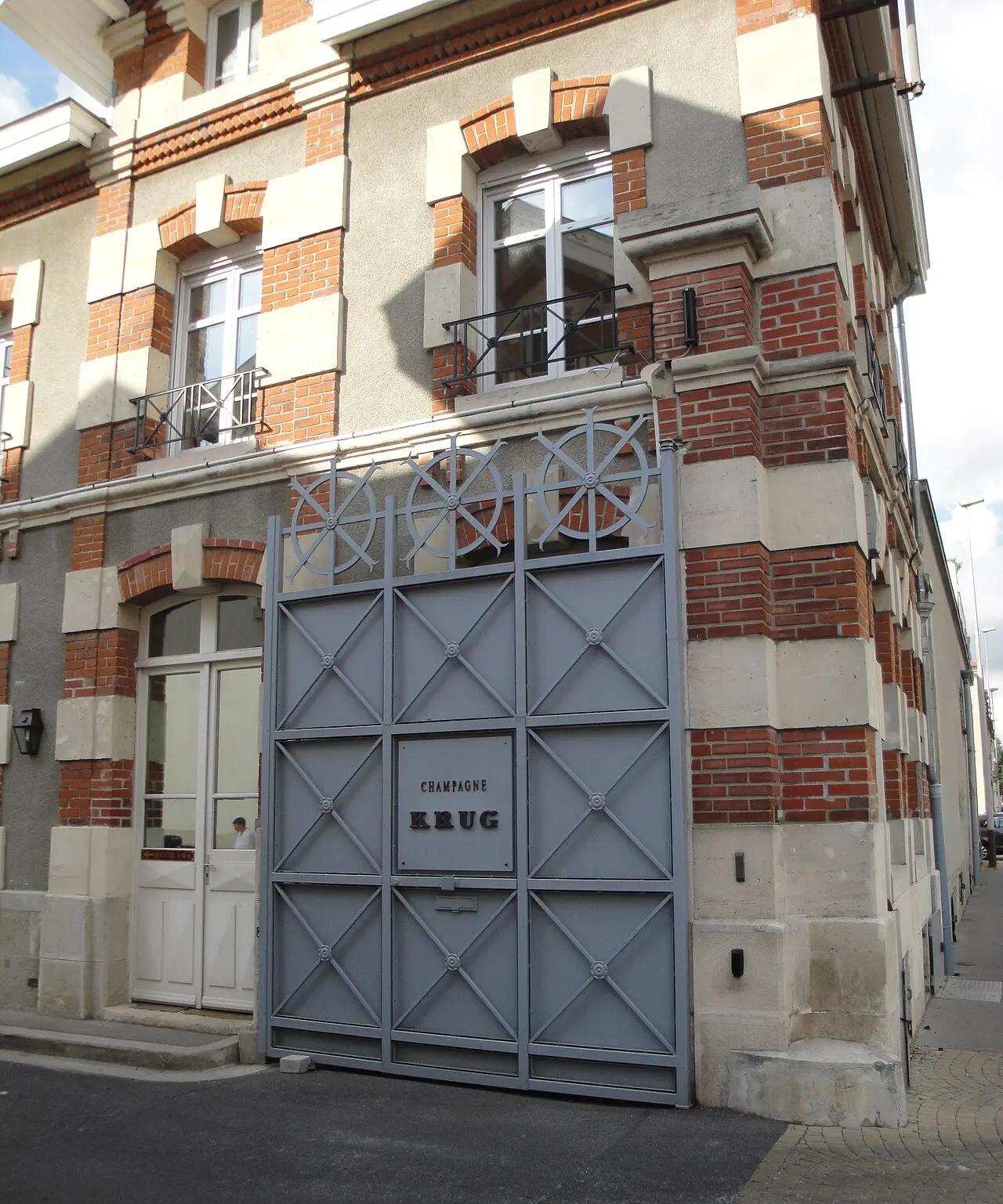
Joseph Krug founded the house in Reims in 1843. Its present contact address is 5 rue Coquebert. The official contact page states twice that the house is not open to the general public.
Official information
Three nearby places with a visitor offer
From Krug’s 5 rue Coquebert address, Mumm lies towards Champ-de-Mars, Cazanove beside place de la République, and Thiénot on rue du Marc. The first and third advertise cellar visits; Cazanove’s contact page offers a tasting reservation.
G.H. Mumm
34 rue du Champ de Mars, 51100 Reimscellar visit- Walking estimate
- 0.4 km · 6 min
- Source
- FOSSGIS/OpenStreetMap · checked 23 October 2026
Charles de Cazanove
8 place de la République, 51100 Reimstasting reservation; production-site visit listed by Comité- Walking estimate
- 0.8 km · 11 min
- Source
- FOSSGIS/OpenStreetMap · checked 23 October 2026
Thiénot — Le N°3
3 rue du Marc, 51100 Reimscellar visit- Walking estimate
- 0.5 km · 7 min
- Source
- FOSSGIS/OpenStreetMap · checked 23 October 2026
A named place to ask for the wines
Les Caves du Forum, 10 rue Courmeaux in Reims, lists Krug Grande Cuvée 173e, Collection 1995 and Millésime 2000 in its own catalogue. Entries marked “En vieillissement” are still maturing; telephone +33 3 26 79 15 15 to discuss a particular bottle and its release. See the venue’s own wine list or catalogueKrug in the shop’s catalogue
Plan nearby visits
Build your visit into a fuller stay with our Reims guide, compare tours and packages and find somewhere comfortable to stay.
Plan your trip to Reims
Get there
Book a tour
Select the departure point and date on the booking page. Check the meeting point, language and inclusions before paying.
Compare toursWe may earn a commission if you book through these links, at no extra cost to you.