
Before you go
The former Reims-Gueux circuit and the Musée Automobile Reims-Champagne are two different stops. One is a surviving roadside racing landscape west of the city; the other is a museum in Reims with published admission and opening arrangements. Decide which interests you before fitting either around a cellar appointment.
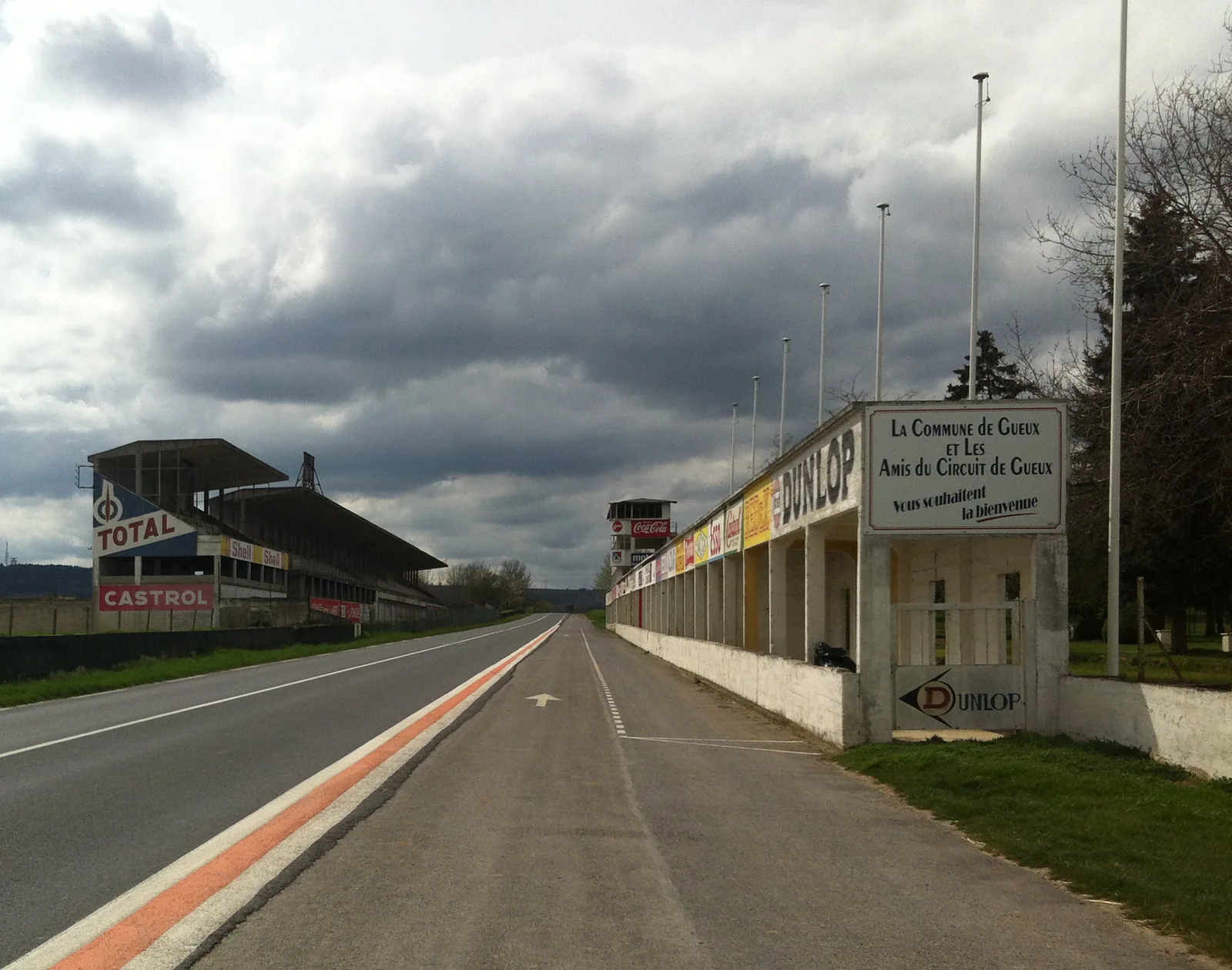
The guide below separates championship history from present-day access. A photograph of the preserved buildings is not proof that the pits or grandstands are open to enter. The hero photograph was taken in 2016; current signs, barriers and the preservation association’s advice govern a visit now.
A short history
Reims-Gueux used public roads between Thillois and Gueux, including the RN31 and the D26/D27. Its place in Grand Prix history can be described precisely: Formula 1’s official result archive records World Championship French Grands Prix here in 1950, 1951, 1953, 1954, 1956, 1958, 1959, 1960, 1961, 1963 and 1966.
Those eleven years are championship rounds, not a complete list of every race held at the circuit. There is a technical distinction for 1953: the World Drivers’ Championship was run to Formula Two regulations in 1952–53, as Ferrari’s historical account explains. Calling all eleven World Championship French Grands Prix avoids confusing championship status with the car rules used in a particular season.
The circuit closed in 1972. The surviving pits and grandstands preserve part of the place where those races were organised, but the present roads continue to serve everyday traffic. Read the historical map and the modern road layout as different documents. An old track outline is background information, not a route to imitate at speed.
Les Amis du Circuit de Gueux are associated with the preservation story; the current Les Passionnés du Circuit de Gueux association also describes work to protect the surviving heritage. Consult their current information when planning a stop, particularly if you hope to enter a building or attend an organised opening.

What survives and where to stop safely
The preserved pit buildings and grandstands are the recognisable reason to come. Look at the relationship between the structures and the road, and keep any visit within the areas currently permitted. Historic signs and a familiar photograph do not establish public access to stairs, roofs, interiors or working areas.
No guaranteed everyday visitor-parking facility or unrestricted opening rule was verified for this guide. Stop only where lawful and clear of traffic, obey local signs and barriers, and ask the association about current arrangements. Do not stop on the carriageway for a photograph or cross without assessing live traffic.
If there is no safe, lawful place to stop, continue and choose another opportunity. A roadside attraction does not remove normal road responsibilities. A passenger can navigate and identify the intended turn before arrival so the driver can concentrate on traffic.
Keep the historic route as a subject for reading, not an invitation to drive a lap competitively. Treat the surviving buildings as heritage structures: do not climb fences, enter a closed section or assume a stair is suitable because it appears in an older image. A planned association opening provides a different kind of access from an incidental roadside view.
Visiting the motor museum
The Musée Automobile Reims-Champagne is at 84 avenue Georges Clémenceau, Reims. Its dedicated practical-information page gives adult admission at €10 (about £9) (checked October 2026). Use that official page for the other ticket categories and any visit-specific conditions.
For October, the museum lists 10:00–12:00 and 14:00–18:00; for November, 10:00–12:00 and 14:00–17:00. It closes on Tuesdays, 1 January and 25 December. The midday closure matters if you are trying to fit it around lunch or a timed house visit.
The official homepage and practical page disagree about the April boundary between seasonal timetables. The October and November hours above agree; for an April visit, obtain the current timetable directly instead of extending one season’s hours by assumption. No unverified visit duration or fixed collection count is promised here.
A museum ticket and a cellar ticket are independent bookings. Put the opening interval, the journey and any meal on the same day plan before paying for a tightly timed combination. For access requirements, contact the museum about the actual route and facilities you need.
Combining with a cellar visit
Choose the confirmed cellar appointment first, then use the museum’s opening interval or a permitted circuit stop in the remaining time. Taittinger and Pommery have their own named programmes and booking entrances. Their presence in Reims does not mean that the museum and either house share a ticket or a single visitor site.
For a road trip, the Champagne by car itinerary connects the cross-Channel journey with a base in the region. Keep the driver’s day alcohol-free and arrange any tasting participation around that decision. A museum or heritage stop provides another interest for a mixed group without relying on a wine appointment.
A room with parking can simplify the Reims portion, but the property’s own parking conditions still apply. Compare the named Reims hotel shortlist, including the parking information on the current property offer. Find hotels in Reims. Do not treat a public car park nearby as a guaranteed reserved hotel space.
Getting there
The old circuit is about eight kilometres west of Reims. This orientation is not a measured driving time or a walking recommendation. Use the current road map and the address information from the association, then follow the signs on arrival. Allow for the distinction between seeing a building from the road and reaching a lawful place to stop.
The museum is within Reims at the address above, rather than at the Gueux site. Use the Reims guide to organise the city portion and the Calais-to-Reims driving guide for the larger journey. Neither source supplies a guaranteed roadside parking space at the circuit.
For anyone arriving without a car, establish the actual outward and return transport before making the circuit the centre of the day. No regular direct visitor shuttle was verified here. The city museum is a separate choice with published opening information, and can be considered without assuming a connection between the two attractions.
Keep the two destinations distinct in a navigation app: the museum’s city address and the circuit association’s Gueux address serve different visits. Save the opening page and the booking confirmation before setting out, and put the next fixed appointment beside them. If the roadside stop is unsuitable on arrival, use the museum or another city activity only if its actual opening hours and your remaining travel time allow it.
More motorsport
A sister-guide link will be added once its homepage address is confirmed. For now, the official race-result archive and local preservation associations in Sources provide the historical and practical starting points.
FAQ
How many championship French Grands Prix were held here?
Eleven: 1950, 1951, 1953, 1954, 1956, 1958, 1959, 1960, 1961, 1963 and 1966, each confirmed in the official result archive.
Can I enter the pits whenever I arrive?
Unrestricted access was not verified. Obey current barriers and signs and consult the preservation association before expecting entry.
Is the museum at the circuit?
No. The museum is at 84 avenue Georges Clémenceau in Reims; the former circuit lies about eight kilometres west of the city.
Does the museum close at lunchtime?
Its published October and November timetables have a 12:00–14:00 break. It also closes on Tuesdays, 1 January and 25 December.
Is there guaranteed free circuit parking?
No current everyday parking guarantee was verified. Stop only where lawful and safe, clear of the carriageway, or continue without stopping.
Plan your trip to Champagne
Get there
Book a tour
Select the departure point and date on the booking page. Check the meeting point, language and inclusions before paying.
From: Reims. Duration: Approximately7 hours. Group size: Maximum 8 participants. Includes: Guide and air-conditioned transfer; E-bike and helmet; Le Clos Corbier visit and lunch; Four wines:two Champagnes,one red wine,one Ratafia. Select Reims pickup option only. Listing checked October 2026.